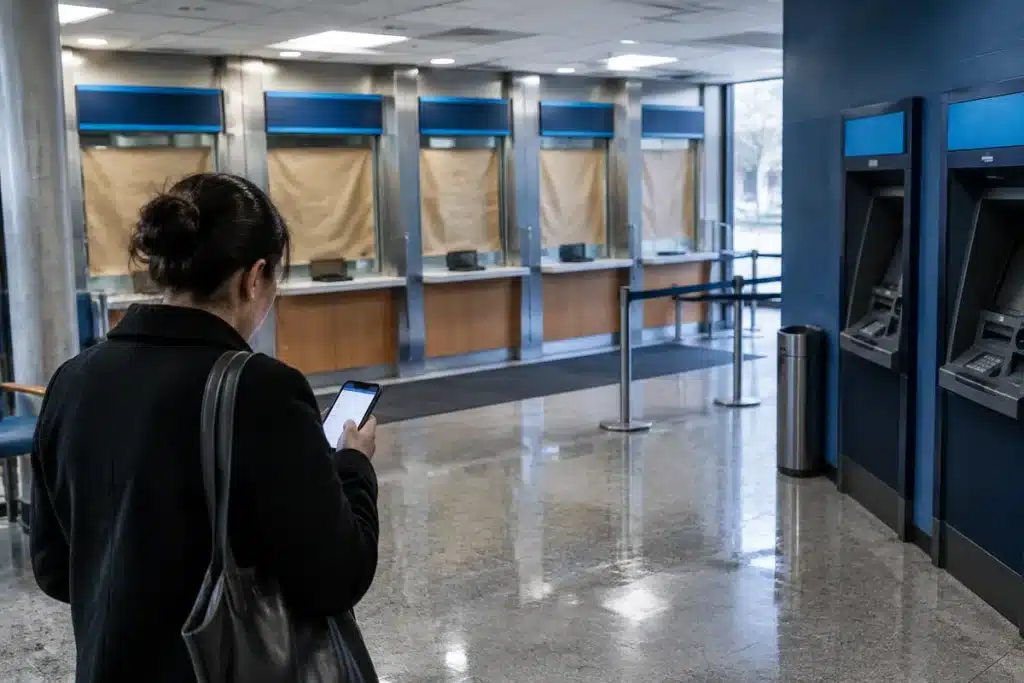
Paraguay woke up to a financial earthquake: the Central Bank has stepped in and taken control of one of the country’s largest lenders, immediately freezing its operations and all customer accounts. For millions of people who used the bank’s app, cards or branches, the move came as a shock — services were shut down overnight and uncertainty surged about access to savings and public funds entrusted to the institution.
Beyond the immediate disruption, the intervention raises questions about governance in the banking sector and the political fallout that often follows crises of this scale. Officials emphasize protection for small depositors and call the episode isolated, but opposition voices and party insiders alike are already mobilizing — turning a banking crisis into a national political story.
The takeover and what was frozen
Paraguay’s Central Bank announced it had taken control of Ueno Bank after determining the institution’s solvency ratio had dropped to less than half the legally required minimum. As part of the resolution, regulators froze both assets and liabilities, effectively stopping every banking service offered by Ueno.
Key facts:
– Customers affected: roughly 3 million people, equivalent to about 60% of the country’s adult population according to the bank’s own figures.
– Public funds frozen: in excess of US$800 million, including about US$380 million managed on behalf of the Social Security Institute (which handles pensions and public healthcare).
– Immediate service suspension: the bank’s app, cards and other services were deactivated so customers cannot transact through any of the institution’s channels.
A Central Bank board member explained that the entity was closed and all services were halted “from today,” underlining the abruptness of the measure.

Which savers are covered and what happens next
Regulators pointed to existing protections while acknowledging that many account-holders will have to wait for final accounting from the banking superintendency.
What depositors should know:
– The Deposit Guarantee Fund insures balances up to 75 minimum wages — roughly 228 million guaraníes, about US$38,200 per person.
– Depositors with balances below that threshold are prioritized for reimbursement.
– Those holding larger sums will need to wait for the Superintendency of Banks to complete the liquidation and final accounting before any recovery is possible.
Central Bank officials stressed the priority will be to protect small savers first, and described the broader banking system as sound despite this single institution’s collapse.

How regulators came to this decision
The takeover followed a months-long probe into the bank’s finances. Investigators uncovered what they described as significant credit exposure to companies linked to the bank’s own owners, a red flag for solvency and governance.
Important pieces of context:
– On October 18, the Association of Banks of Paraguay had urged the Central Bank to assess institutions that had benefited from merger-related concessions, flagging concerns about a bank’s concentration of credit risk within its own group.
– Senators from both the ruling party and opposition had recently called on President Santiago Peña to remove the Central Bank’s leadership amid mounting scrutiny; Peña supported the dismissal request.
– Carlos Carvallo, the Central Bank president, previously ran Ueno Bank before his 2023 appointment. He said he signed his resignation but will stay in office until the bank’s resolution is finalized.
Reports in the local press indicated several Ueno executives were detained during the investigation, including the bank’s president, Miguel Vázquez.
Political ripple effects and immediate reactions
The financial move quickly became political. High-level figures adjusted plans and opponents seized on the crisis to escalate pressure.
Notable political reactions:
– Vice President Pedro Alliana announced he was pausing his campaign for the ruling Colorado Party’s presidential nomination, saying he needed to “put the house in order.”
– The Authentic Radical Liberal Party (opposition) signaled it would push for impeachment proceedings against President Santiago Peña and Vice President Alliana, accusing the government of allowing misappropriation of pension funds.
– Opposition presidential hopeful Ricardo Estigarribia publicly accused officials of having “plundered pensioners’ money,” calling for accountability.
The episode also reopened scrutiny of earlier transactions between public agencies and the bank. In 2024 the Social Security Institute purchased approximately US$32 million in bonds issued by the bank — a deal that previously sparked controversy. President Peña has said those reports were part of a media campaign; he was a shareholder in Ueno Holding (not the bank itself) and sold his stake in April 2025.
Practical steps for customers and what to watch
For now, customers face a period of uncertainty. Regulators advise calm and outline a few immediate actions and expectations.
Recommended actions:
– Keep documentation: retain account statements, transaction records, and any correspondence with the bank.
– Avoid sharing personal credentials: do not respond to unsolicited requests for login details or personal information.
– Monitor official channels: the Central Bank and the Superintendency of Banks will publish updates on reimbursements, timelines and procedures.
– Check eligibility for deposit insurance: determine if your balance falls under the 75 minimum wage coverage to estimate likely recovery.
What to expect next:
– A formal accounting process by the Superintendency of Banks to determine recoverable assets and creditor rankings.
– Prioritization of small depositors for rapid reimbursement; longer waits for larger creditors and institutional creditors such as the Social Security Institute.
– Continued political debate and possible legal actions as investigations into linked-party lending and executive responsibility progress.
(here the article continues with practical guidance and ongoing developments)
Similar Posts
- Frozen Ueno Bank savings: Paraguay demands partial return within 24 hours
- Paraguay Central Bank under pressure: lenders’ solvency doubts escalate
- HSBC Exits Uruguay: Sells Operations to Top Brazilian Bank
- Bolivian Crisis: President Labels Country a “Sewer of Extraordinary Proportions”
- Argentina Decides: Will Central Bank Stop Funding the Treasury? Vote This Week!

Gavin Turner is a crypto market analyst with over seven years studying price fluctuations and trading volumes in the United States. He provides detailed reports on sector trends and key indicators to help you anticipate market moves. His rigorous methodology and reliable forecasts guide you in refining your crypto trading strategies.