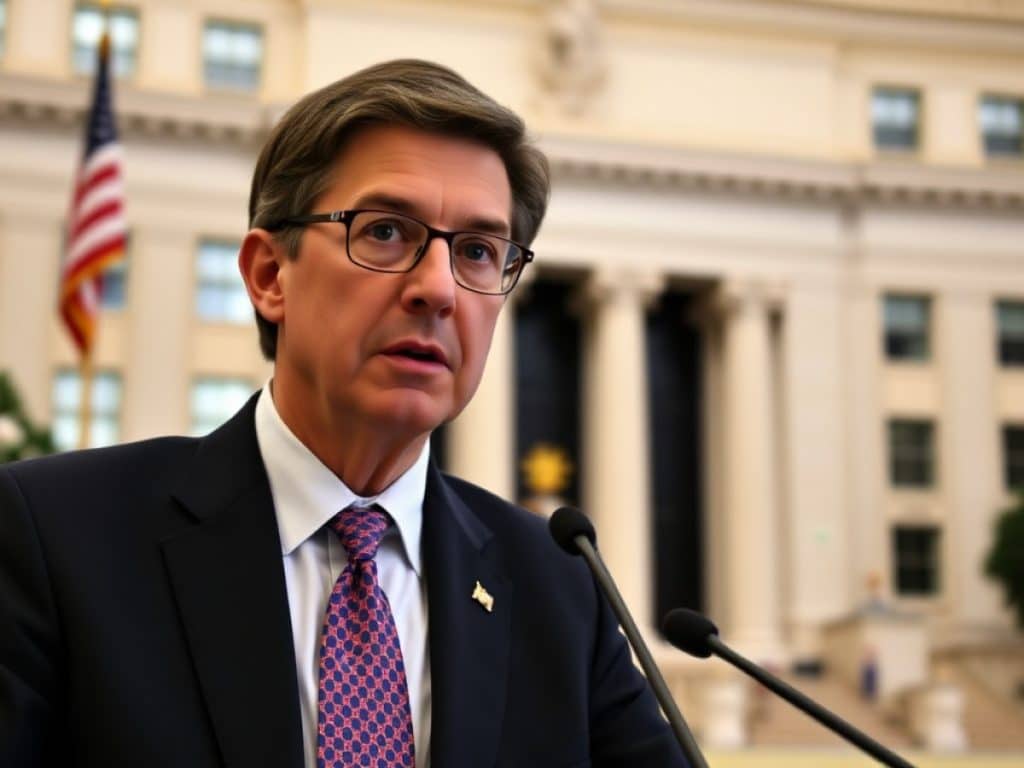
In a significant move that sets the tone for his tenure, the new chairman of the US Federal Reserve, Kevin Warsh, has started his leadership with a firm decision to keep interest rates steady. This decision was made during his first meeting as chairman, where rates were held at a range between 3.5% and 3.75%. This move comes after a previous rate reduction by three-quarters of a percentage point in late 2025, signaling a cautious approach to monetary policy amid varying economic signals. Warsh’s inaugural meeting was not just about maintaining the status quo on interest rates but also marked by a notably succinct policy statement, which could be a harbinger of more streamlined communications from the Fed under his leadership.
The brevity and clarity of the Federal Open Market Committee’s (FOMC) statement under Warsh’s new guidance were apparent, with the statement being significantly shorter than previous ones. This change is part of Warsh’s broader strategy to overhaul the Fed’s communication and forecasting methods. The chairman did not provide a personal economic forecast at the press conference, indicating a shift towards less predictive and more moment-to-moment policy formulation. This approach, according to Warsh, is aimed at enhancing the effectiveness and transparency of monetary policy.
Decisions and Directions: The First Meeting with Chairman Warsh
The unanimous decision to hold the interest rates reflects a continuity in the Federal Reserve’s cautious approach to managing the economy. This decision was influenced by current economic conditions and future uncertainties, particularly concerning inflation and employment.
– **Interest Rates Unchanged:** The Fed’s decision reflects ongoing concerns about economic stability and inflation pressures.
– **Future Projections:** The median estimate for the fed funds rate by the end of 2026 is now at 3.8%, suggesting that the Federal Reserve might lean towards tightening the monetary policy slightly if economic conditions demand.
Revamping Fed Communications
Chairman Warsh has expressed dissatisfaction with the existing forecasting tools and the overall strategy of forward guidance employed by the Federal Reserve. His criticisms are not just limited to the tools but also to the way economic projections are communicated to the public and investors.
– **Reduced Predictive Guidance:** Warsh’s reluctance to share detailed forecasts marks a significant shift from the Fed’s previous communication strategy.
– **Task Forces for Overhaul:** He announced the formation of task forces aimed at reviewing and possibly overhauling the Fed’s operations, including its communication practices.
Immediate Changes in Communication
The recent FOMC statement was a testament to Warsh’s new communication policy. At just 130 words, it was far shorter than the 341-word statement from the previous meeting, focusing more on direct facts and less on interpretative language.
– **Concise and Factual Statements:** The FOMC statement under Warsh’s leadership offered a straightforward summary of the economic conditions, emphasizing the commitment to controlling inflation without delving much into detailed projections.
Economic Conditions and Policy Implications
Despite the geopolitical tensions and other external shocks affecting the economy, the Federal Reserve’s latest policy statement highlighted several positive aspects of the current economic landscape:
– **Solid Economic Expansion:** The economy continues to grow at a robust pace, supported by strong productivity growth and capital investment.
– **Employment and Inflation:** The labor market remains resilient, with job gains matching workforce growth, although inflation continues to overshoot the Fed’s 2% target due primarily to external supply shocks.
In his brief time as chairman, Kevin Warsh has started to imprint his vision on the Federal Reserve, emphasizing a more pragmatic and less predictive approach to monetary policy. This could signal a significant shift in how the central bank interacts with global markets and policymakers. As the year progresses, it will be crucial to watch how these changes influence economic policy and market reactions.
Similar Posts
- Trump Appoints Kevin Warsh as Federal Reserve Leader: High-Stakes Confirmation Battle Looms
- Warsh Takes Over Fed Amid Soaring Inflation: What This Means for Your Wallet
- Fed Maintains Interest Rates Again: Three Officials Advocate for Increase
- Xi Pushes for Stronger Renminbi: Trump Plans Shift at Fed’s Helm
- Trump Vows to Fire Powell if He Remains After May: Senate Confirmation Delays Explained

Gavin Turner is a crypto market analyst with over seven years studying price fluctuations and trading volumes in the United States. He provides detailed reports on sector trends and key indicators to help you anticipate market moves. His rigorous methodology and reliable forecasts guide you in refining your crypto trading strategies.